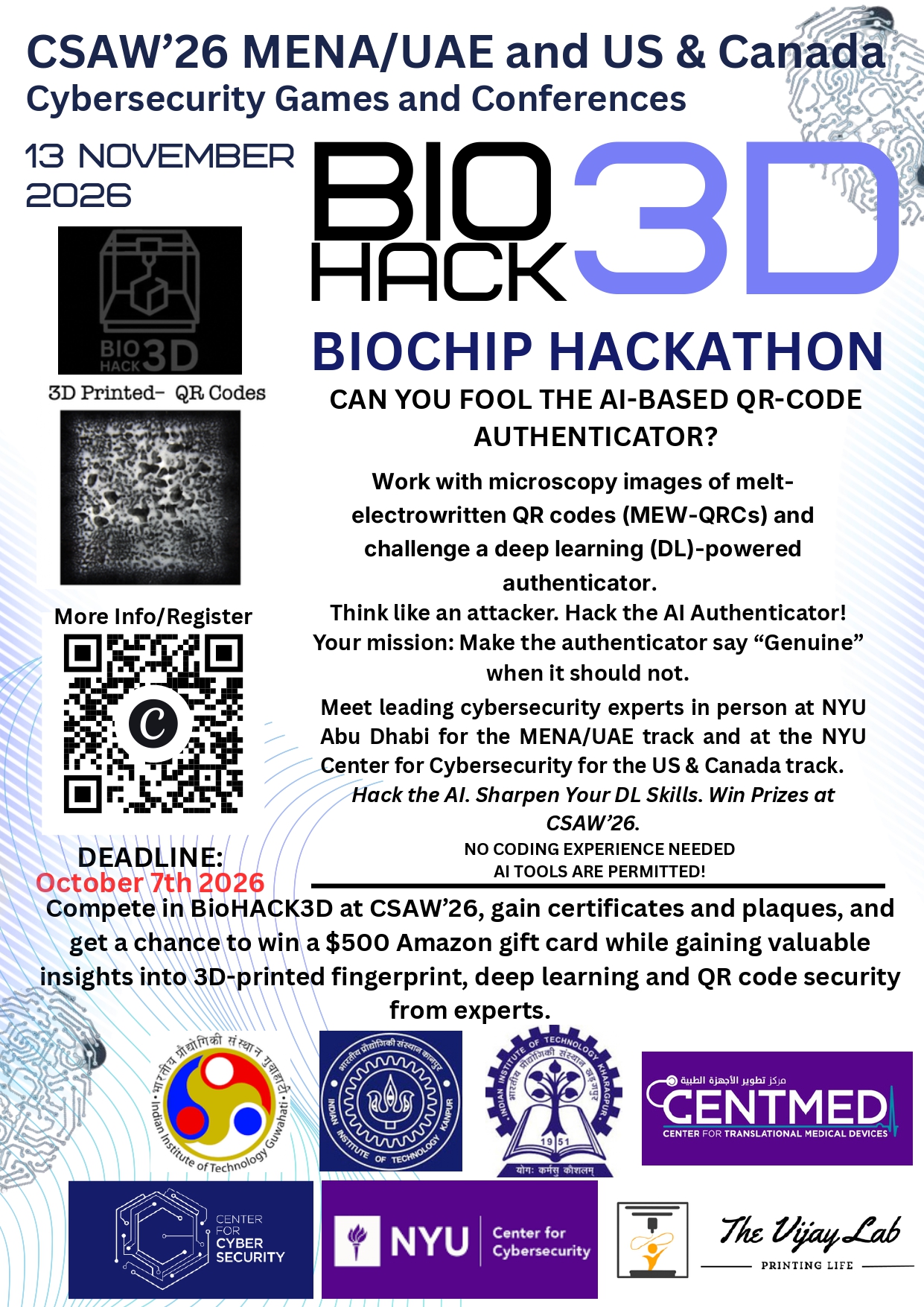
BioHack 3D
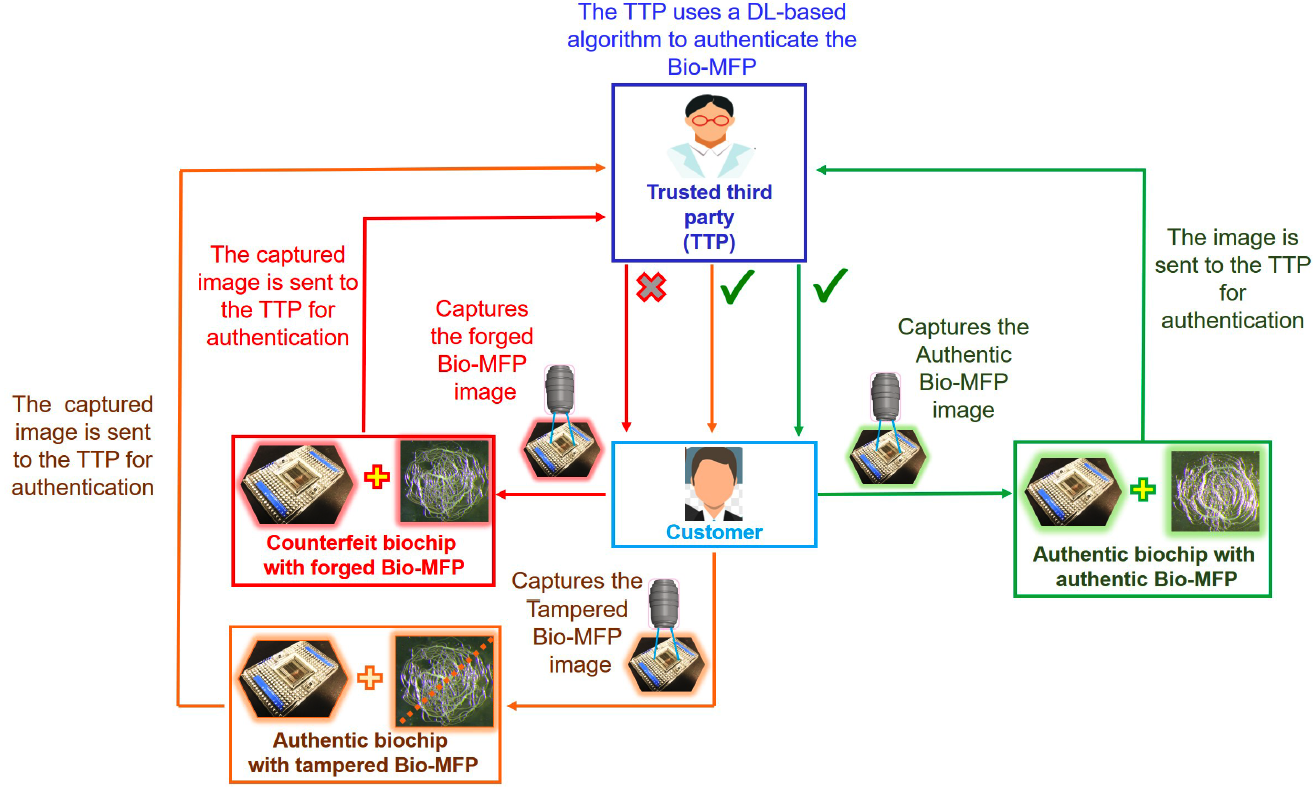
A trusted third party (TTP) uses a DL-based authentication system to decide whether a submitted melt-electrowritten QR code (MEW-QRC) is genuine.
The green route is the legitimate path: an authentic MEW-QRC is captured, submitted, and accepted.
The real question is what happens along the red and orange routes.
Can you manipulate, counterfeit, or strategically alter an MEW-QRC image so convincingly that the authenticator makes the wrong decision?
Your Mission
Think like an attacker. Challenge the AI. Find the weakness.
Your objective is to explore whether a forged or manipulated MEW-QRC can cross the authentication barrier and be incorrectly classified as genuine.
You may investigate how the system responds to:
- subtle image manipulation and perturbations,
- counterfeit or reconstructed MEW-QRC patterns,
- changes in morphology, texture, orientation, or image quality,
- physical and imaging variations that could confuse the authentication model.
The ultimate goal is simple:
Can you turn an attack route into an accepted authentication?
In other words:
Can you flip the outcome: make the X on the red route a ✓ and the ✓ on the orange path an X, as authenticated by the TTP?
BioHACK3D challenges you to combine AI, computer vision, cybersecurity, and creative problem solving to probe the limits of a real physical-authentication problem.
Break the assumption. Challenge the model. Fool the authenticator.
BioHack 3D 2026
Think Like an Attacker. Challenge a Deep-Learning QR-Code Authenticator.
BioHACK3D 2026 puts you against an AI-powered physical-authentication system built to recognize genuine melt-electrowritten QR codes (MEW-QRCs).
Your Challenge
Explore the authentication pipeline, probe its weaknesses, and determine how robust the DL-based verifier really is.
- Work with MEW-QRC image datasets provided by the organizers.
- Examine the microscopic and morphological features that drive authentication.
- Apply ideas from computer vision, image processing, AI/ML/DL, and adversarial learning.
- Investigate how image manipulation, counterfeiting, cloning, noise, deformation, or other physical and imaging variations may influence the verifier.
- Develop a creative and realistic strategy for challenging the DL-based authentication decision.
- Evaluate your approach in terms of attack effectiveness, computational cost, latency, scalability, and practical feasibility.
The Goal
Can you find a weakness in the authentication pipeline and exploit it convincingly enough to challenge the AI's decision?
Bring your computer-vision skills, adversarial-ML ideas, cybersecurity mindset, and creativity to BioHACK3D 2026.
Find the weakness. Challenge the model. Test the limits of AI-powered physical authentication.
Have your solution evaluated by experts in AI, 3D printing, biochip security, and cyber-physical systems.
- Each team will compete within its designated region — MENA (UAE Only) or US & Canada.
- Submissions must reflect the team’s original creativity, technical insight, and effort.
- Teams will work with the MEW-QRC datasets and challenge information provided by the organizers.
- The objective is to investigate the supplied DL-based authentication pipeline and develop a technically convincing strategy for challenging its authentication decision.
- Finalist teams must submit a short technical report using the provided template and a 4–5-minute demonstration video/online presentation.
- Finalist teams are responsible for arranging and covering their own transportation to the respective CSAW venue. Travel support will not be provided.
Attack Effectiveness - How successfully does the proposed strategy challenge the DL-based MEW-QRC authenticator? As part of the evaluation, the judges will act as the Trusted Third Party (TTP) and test the submitted modified, manipulated, or counterfeit MEW-QRC images using the organizers’ DL-based authentication framework. Performance will be judged by the extent to which the submitted samples can influence the authenticator toward an incorrect acceptance decision.
Technical Soundness - Are the attack methodology, assumptions, experiments, and conclusions technically well justified?
Stealth & Realism - How plausible is the proposed attack under realistic imaging, computational, and physical constraints?
AI/Computer-Vision Innovation - Creative use of AI/ML/DL, computer vision, image processing, adversarial methods, or related techniques.
Experimental Evidence - Quality of the results and dataset-based evidence demonstrating the effectiveness and limitations of the proposed approach.
Practical Feasibility - Consideration of computational cost, latency, scalability, resources, and deployability of the attack strategy.
Novelty & Creativity - Originality of the team's approach to identifying and exploiting weaknesses in the authentication pipeline.
Technical Report & Demonstration - Clarity, coherence, reproducibility, and quality of the final report, presentation, and demonstration.
- Eligibility: Undergraduate and Postgraduates
- Team Size: 2–4 members; cross-institution teams are allowed
- Selection: Qualifying round conducted through the BioHACK3D registration form
- Registration Deadline: October 7, 2026
- Regional Participation: Teams compete within their respective region — MENA (UAE teams only) or US & Canada
Qualifying Round
- Complete the technical questions provided in the registration form.
- Demonstrate your understanding of MEW-QRCs, computer vision, AI/ML/DL, physical authentication, and relevant security threats.
- Selected teams will advance to the BioHACK3D 2026 Final Round.
Final Round
- Finalist teams will receive the competition dataset and detailed challenge instructions.
- Develop and evaluate a strategy for challenging the DL-based MEW-QRC authentication system.
- Generate or modify MEW-QRC images according to the competition rules.
- The submitted challenge images will be tested by the organizers/judges acting as the Trusted Third Party (TTP) using the organizers’ DL-based authenticator.
- Submit a short technical report describing the approach, methodology, experiments, and results.
- Present the solution before an expert judging panel at the respective CSAW 2026 venue.
Certificates will be awarded to the top three teams in each region.




Previous editions
- BioHack 3D 20252025